
Fashion
The Art of Creating a Unique and Timeless Fashion Look


Some fashion labels follow the culture, while others create their own world and invite people to become part of it. Comme des Garçons and Chrome Hearts belong to the latter category. Both have developed recognizable identities that attract fashion enthusiasts looking for something beyond ordinary clothing. One explores unconventional design and artistic expression, while the other blends luxury craftsmanship with rebellious, gothic-inspired details.
Although Comme des Garçons, often shortened to CDG, and Chrome Hearts approach fashion differently, they share an important quality: neither depends entirely on conventional trends. Their designs encourage people to experiment with their appearance and develop a more personal relationship with clothing. From a graphic CDG hoodie to a distinctive Chrome Hearts shirt, these labels offer different ways to make everyday fashion feel more expressive.
Two Brands That Refuse to Blend In
Comme des Garçons has earned recognition for challenging traditional ideas about clothing. Its fashion identity is associated with experimental silhouettes, unexpected proportions, artistic concepts, and designs that sometimes question conventional definitions of beauty. Rather than repeating one recognizable formula, Comme de Garcons explores different creative directions across its collections.
Chrome Hearts has built a contrasting identity around luxury, rock-inspired influences, gothic motifs, detailed graphics, and distinctive accessories. Its clothing often makes a strong visual statement through recognizable design elements and decorative finishes. While CDG can challenge expectations through shape and concept, Chrome Hearts frequently communicates its attitude through bold imagery and craftsmanship.
The CDG Mindset: Fashion Without a Formula
The appeal of Comme des Garçons comes from its willingness to explore ideas that extend beyond conventional streetwear. Unusual construction, oversized proportions, asymmetrical shapes, and unexpected combinations can make a garment feel closer to a creative statement than a basic wardrobe essential. This approach attracts people who appreciate clothing that encourages experimentation.
Not every CDG piece needs an elaborate outfit to make an impression. A distinctive graphic shirt can work with simple denim, while an unconventional top can become the focus of a carefully balanced combination. The brand’s creative identity gives wearers room to interpret its designs in their own way rather than following a single styling rule.
Chrome Hearts Brings Luxury With an Edge
Chrome Hearts occupies a distinctive position between luxury fashion and alternative culture. Its visual language often includes cross motifs, bold lettering, silver hardware, and dramatic graphics that give its clothing and accessories a recognizable character. This combination creates a style that feels expressive without relying on traditional luxury minimalism.
A Chrome Hearts hoodie illustrates this attitude particularly well. The familiar silhouette makes it easy to wear, while the brand’s distinctive detailing can give the outfit a stronger personality. Paired with relaxed denim, understated sneakers, or simple trousers, the hoodie can become a statement piece without making the entire look feel complicated.
Why CDG and Chrome Hearts Appeal to Collectors
Fashion enthusiasts often value more than the immediate appearance of a product. Design history, recognizable details, cultural influence, and personal meaning can all contribute to the appeal of a particular garment. Comme des Garçons attracts collectors who appreciate experimental design, while Chrome Hearts appeals to people drawn to its combination of luxury craftsmanship and rebellious visual identity.
Collectors may also enjoy searching for particular graphics, silhouettes, accessories, or releases that fit their personal interests. However, popularity alone does not guarantee that a product is worth purchasing. The most satisfying additions to a collection are usually pieces that connect with the owner’s taste and can be appreciated beyond a temporary trend.
The CDG Hoodie in Everyday Streetwear
The CDG hoodie has become a familiar option for people who want casual clothing with a recognizable design identity. Depending on the particular line and model, it may feature graphic elements, distinctive branding, or a more understated appearance. Its casual structure makes it relatively easy to incorporate into everyday outfits.
For a relaxed look, pair a CDG hoodie with straight-leg jeans and simple sneakers. If you prefer a more fashion-forward combination, experiment with wider trousers, layered outerwear, or contrasting proportions. Keeping the remaining pieces relatively simple can help the hoodie stand out without overwhelming the outfit.
When shopping, check the exact product line and design details. Comme des Garçons includes different labels and collections, so not every item carries the same aesthetic or construction. Understanding which line you are buying helps you choose a piece that matches your preferences.
Chrome Hearts Shirts: Bold Details, Strong Identity
A Chrome Hearts shirt can give an everyday outfit a more distinctive character through its graphics, lettering, and recognizable design elements. It works naturally with denim, relaxed trousers, and casual footwear, making it suitable for people who prefer expressive clothing without needing a complicated combination.
Styling depends on the shirt’s particular design. A heavily graphic piece may look best with understated trousers and minimal accessories, while a simpler design leaves more room for layering. The goal is to establish a clear visual focus and let the garment contribute to the outfit’s overall identity.
Chrome Hearts shirts can also be incorporated into different seasonal wardrobes. In warmer weather, they can be worn as standalone pieces, while cooler conditions allow for layering beneath jackets or overshirts. Choosing the right fit and fabric for your needs helps balance style with everyday comfort.
Jewelry That Gives Chrome Hearts Its Signature Edge
Accessories are an important part of the Chrome Hearts aesthetic. Chrome Hearts jewelry, including rings, bracelets, and necklaces, is often recognized for its bold silver designs and gothic-inspired detailing. These pieces can introduce texture and visual interest to an outfit without requiring a graphic-heavy garment.
A single ring or necklace may be enough to complement a simple shirt, while several accessories can create a more expressive layered look. Balance is important, particularly when the clothing already includes substantial graphics or decorative details. Thoughtful combinations often look more intentional than wearing every statement piece at once.
For shoppers interested in jewelry, material descriptions, dimensions, product details, and authenticity are worth checking carefully. Because sought-after designer accessories can appear on resale platforms, buying from reputable sellers and reviewing return policies can help reduce unnecessary risk.
Can Comme des Garçons and Chrome Hearts Work Together?
Combining inspiration from CDG and Chrome Hearts can produce an interesting contrast between experimental design and rebellious luxury. The key is to treat each item as part of a complete outfit rather than trying to make every piece equally noticeable. A distinctive CDG garment can work alongside understated accessories, while a bold Chrome Hearts piece can provide the main visual statement.
For example, an unconventional top can be paired with straightforward denim and simple footwear. Alternatively, a Chrome Hearts shirt or hoodie can be balanced with relaxed trousers and restrained layering. These combinations allow differences in texture, proportion, and graphic style to create interest without making the outfit feel crowded.
It is important to distinguish between personal styling and an official collaboration. Wearing products from both brands in the same outfit does not mean they were jointly released. When buying a product described as a collaboration, verify the listing and supporting details rather than relying solely on its title or photographs.
Building a Wardrobe That Reflects Your Personality
A distinctive wardrobe does not need to consist entirely of designer pieces. Often, a few carefully selected garments can make everyday clothing feel more personal. Comme des Garçons can provide experimental shapes or artistic graphics, while Chrome Hearts can introduce bold details, expressive shirts, or statement accessories.
Begin with the clothing you already enjoy wearing. If your wardrobe contains mostly basic T-shirts and denim, a distinctive hoodie or graphic shirt may offer an easy way to introduce variety. If you prefer unconventional proportions, a CDG Converse design may provide more opportunities to experiment with silhouette and layering.
Color coordination can also make a difference. Neutral shades create a versatile foundation, while carefully chosen contrasting colors can add energy. Rather than copying a complete outfit from social media, focus on the individual elements that appeal to you and adapt them to your own preferences.
Social Media, Fashion Hype, and Cultural Influence
Social media has accelerated the way fashion trends spread. A particular outfit, accessory, or graphic can become widely recognized in a short period, influencing what consumers search for and purchase. Chrome Hearts and CDG benefit from strong visual identities, but their appeal extends beyond online visibility.
Comme des Garçons has influenced conversations about fashion as artistic expression, while Chrome Hearts has connected luxury clothing and accessories with rock-inspired aesthetics. These different cultural associations help explain why both labels attract people who want their wardrobes to communicate more than a preference for popular brands.
Still, hype can create pressure to buy items simply because other people are wearing them. Developing personal style means learning to separate genuine interest from temporary excitement. Choosing pieces that fit your taste, budget, and lifestyle is often more rewarding than constantly chasing the newest trend. For those looking to express their personal style, hair extensions can also be a versatile way to add length, volume, and variety to different hairstyles while complementing a unique and timeless fashion look.
Shopping for Designer Fashion With Confidence
Before purchasing Comme des Garçons or Chrome Hearts, consider the item’s intended use, fit, materials, and compatibility with your existing wardrobe. A versatile shirt may be worn regularly, while an unusual statement piece might be better suited to specific outfits. Understanding how often you will use a product can help you assess its value.
Authenticity deserves particular attention when shopping online or through resale channels. Review seller information, product photographs, labels, construction details, and return policies. An expensive price or familiar logo alone cannot establish that an item is genuine, so seek reliable evidence when authenticity matters.
It is also useful to compare sizing information across individual product lines. Different garments may have different cuts, proportions, and fits, especially when comparing conventional streetwear pieces with experimental designs. Careful research helps reduce the likelihood of purchasing something that does not meet your expectations.
What Makes Their Influence Last?
Fashion labels can become popular through temporary trends, but maintaining a recognizable identity requires something more substantial. Comme des Garçons continues to stand out through experimentation and an artistic approach to design. Chrome Hearts has built its own visual world through distinctive motifs, expressive clothing, jewelry, and a luxury identity influenced by alternative culture.
Their continued relevance demonstrates that fashion does not have to follow one definition of sophistication. Some people prefer unconventional shapes and conceptual designs, while others are drawn to bold graphics and detailed accessories. Both preferences can coexist within a modern wardrobe, giving consumers more freedom to explore individual style.
The Final Word: Your Style, Your Rules
Comme des Garçons and Chrome Hearts represent two different ways of challenging ordinary fashion. CDG offers creative experimentation and unconventional design, while Chrome Hearts combines luxury craftsmanship with a rebellious, gothic-inspired identity. Their differences are precisely what make them interesting to fashion enthusiasts who want alternatives to predictable trends.
Whether your preference is a CDG hoodie, a Chrome Hearts shirt, distinctive Chrome Hearts jewelry, or a more experimental garment, the best choice is one that feels authentic to you. Build outfits around pieces you genuinely enjoy, pay attention to fit and quality, and experiment without feeling obligated to follow every trend. The result is a wardrobe that reflects personal taste rather than simply repeating what is popular.

Somebody asks you which of the two is lighter and you genuinely can’t answer it from a screen. Dark Oatmeal and Off-White sit a couple of squares apart on the 1977 page at Essentialscanadashop, both landing somewhere in the $99 to $116 band against an original tag near $500, and on a phone held at arm’s length they read like the same hoodie photographed twice on two different afternoons. Except one of them is warm and the other is cold, which sounds like a footnote right up until it’s on you and the thing is reading as either oatmeal or bedsheet.

So: undertone. That’s basically the whole thing — undertone, plus what each one looks like after a year of actually being worn.
Warm beige wearing a neutral costume
Dark Oatmeal has beige in it. Not much — nobody would call it tan — but there’s a yellow-brown pull sitting under the gray, and it shows up the second the hoodie is next to something properly white. Unbleached paper. The inside of a cardboard box that’s been in a dry garage a while. That family.
Off-White goes the other direction entirely. Cool near-white with a faint gray shift, closer to wall primer than to cream, no yellow worth mentioning — which means the two aren’t neighbors on a color wheel at all, even though the thumbnails make them look like cousins. They’re opposites that happen to land at a similar brightness, and brightness is pretty much all a small product photo communicates.
There’s a one-second test if you own a plain white tee. Lay it on the hoodie. Off-White looks like a slightly dirtier version of the tee, same temperature. Dark Oatmeal looks like a different material.
The two, line by line
Here’s the comparison I’d want in front of me before ordering either one, built around what the hoodies do rather than what the swatch names suggest:
| Dark Oatmeal | Off-White | |
| Undertone | Warm, yellow-brown under the gray | Cool, faint gray, no yellow |
| Reads as | Unbleached paper, dry cardboard | Primer, chalk, a washed bedsheet |
| In daylight | Deeper, almost tan at the seams | Flattens out, can look stark |
| Under warm bulbs | Glows, looks more expensive | Takes on the yellow of the lamp |
| In photos | Lighter than it is | Grayer than it is |
| Coffee and cooking oil | Buried for a day or so | Visible right away |
The photo row is where people get burned, and cameras are mostly to blame. Auto white balance hunts for something it can treat as neutral, then drags everything toward that guess — warm beige under cool studio lights gets corrected pale, a cool near-white near a wooden floor gets nudged warm, and both land on roughly the same shade on your screen. So I’d trust the color name over the picture. Every time.
Which one your face likes, and what’s already folded on the shelf
Skin tone counts for more here than it does on black, where everybody more or less gets away with it. Green veins at the wrist, gold jewelry that’s always suited you better than silver — that’s the crowd Dark Oatmeal quietly flatters, handing a bit of warmth back up to your face rather than fighting it. Cool or pink undertones and the whole thing inverts, with Off-White staying crisp on you while oatmeal goes a little muddy, as if the hoodie sat on a dusty shelf for a week.
Very fair and very cool at once is the one real trap. Off-White against pale pink skin erases the line where the fabric stops and the neck starts, especially in flat February light, so I’d take Dark Oatmeal there and break the rule on purpose.
Then there’s the closet question, which honestly settles it for most people. Off-White argues with anything else in the outfit trying to be white — a white tee under it, white sneakers — so it wants contrast instead: black pants, dark indigo, or the Iron and Dark Gray pieces further down the same 1977 Hoodie run. Dark Oatmeal is the easier roommate by a mile, sitting beside Wheat or Brown or washed denim without anybody noticing a clash, which is usually what people mean when they call a color safe.
Year two: shine, cuffs and the coffee problem
Both are cotton fleece, and pale cotton fleece does one entirely predictable thing — the cuffs and hem go gray before anything else, because that’s where your hands and the arms of every chair you sit in live. On Dark Oatmeal that grayness settles into the warmth that’s already there and reads as wear. On Off-White it reads as needing a wash, even when it just came off the line.
Stains split along the same line. Coffee, olive oil, the dripping end of a taco — all warm-toned, all of it half-vanishes into oatmeal for a day and sits on Off-White like a planted flag. Indigo transfer from stiff new jeans shows up on both of them, to be fair, and there’s no version of pale cotton that escapes that one.
Care is identical for the pair, which is inside out, cold water, like colors only, low iron, hung up rather than tumbled. Bleach is the thing to skip on Off-White especially, however tempting a dingy cuff makes it look.
| Pro Tip: Buy the one you’d reach for on an overcast Tuesday, not the one that photographed better. Dark Oatmeal is also the cheaper mistake to make, because there’s no cash back here — store credit or a swap inside 30 days, tags on, nothing worn or washed — so a half-liked color becomes money parked on the site. |
Frequently Asked Questions
Is Dark Oatmeal just a lighter gray?
No. Gray is neutral or cool at its base and oatmeal has that yellow-brown sitting underneath, and since there’s an actual Dark Gray in the same 1977 lineup you can check it yourself — one looks like stone, the other like paper.
Will Off-White end up looking cheap?
Only if it’s the wrong white for the room you’re standing in. Warm bulbs push it toward cream and most people like it there. Cold overhead office lighting flattens it and it can go a bit clinical. That’s the lighting talking, not the fleece.
Which of the two survives a kid, a commute and a dog?
Dark Oatmeal, without much of an argument. It isn’t dark enough to hide everything, obviously, but it buys a day of grace on warm-toned mess and the grubbiness that builds at the cuffs looks broken-in rather than neglected.
Hold the two names up against the gold-or-silver question and whichever metal sits better on your wrist is pointing at your hoodie. Stock on this line moves, and colors here don’t always come back once they’re gone, so it’s a decision worth making this week rather than next.
Picking a size off a dropdown that runs from S all the way up to 4XL feels simple enough, right up until you notice that the chart sitting underneath it stops four sizes earlier. That’s the situation across the hoodies and tees listed as Tyler The Creator Merch, and it trips people up at checkout more often than it should. Six sizes in the menu. Four in the chart.

I’d rather put that plainly than dance around it. The product pages carry no fabric weight, no body length and no sleeve measurement — what you get is a chest and a waist range for four sizes, in centimeters, plus a short list of construction details. Which is workable, honestly, as long as you know exactly what you’re working with before you commit.
What those four rows actually tell you
The size chart covers S, M, L and XL, and it gives two numbers per size — chest and waist, both as ranges, both in centimeters rather than inches. Converted over for a US reader who thinks in inches, the four rows land roughly here.
| Size | Chest (cm) | Waist (cm) | Chest (approx. inches) |
| S | 96–101 | 76–81 | 38–40 |
| M | 102–107 | 82–87 | 40–42 |
| L | 108–113 | 88–93 | 42.5–44.5 |
| XL | 114–119 | 94–99 | 45–47 |
Notice the steps. Every size climbs six centimeters in the chest and six in the waist too, and because the bands never overlap, a 103 cm chest lands in M and nowhere else. The bands are tight. That’s handy when your own measurement lands somewhere in the middle of one, and a bit awkward when it falls on a boundary like 101 or 107, where either size has a case and the looser of the two tends to hang better on a printed hoodie anyway.
Above XL the numbers simply stop
XXL and XXXL show up in the dropdown on most pieces. Some push on to 4XL, and there’s a graphic tee that runs all the way to 5XL. Not one of them shows in the chart. There’s no published chest for XXL, no waist for 4XL, nothing at all above that fourth row — and I’m not about to invent a number to fill the hole, because a guess dressed up as a measurement is worse than an honest gap.
What I will say is what the published part hints at. If that six-centimeter step carried on, XXL would land somewhere near 120–125 cm through the chest and XXXL near 126–131. That’s my arithmetic off the four rows the shop gives, though, not a figure from the shop, and extended sizes in cut-and-sew clothing often jump on a different pattern once they get past XL. So treat it as a rough bearing and nothing firmer.
And above XL, an email with your chest measurement before you order costs you nothing. Returns run on exchange and store credit rather than cash back, so asking first beats sorting a swap later.
A tape measure beats a guess, and it takes about a minute
The chest measurement a chart like this means is the one taken around the fullest part of your chest, under the arms, with the tape level and snug instead of hauled tight — and taken while you’re breathing normally, which sounds too obvious to mention and still throws the reading off by a couple of centimeters when people forget. A result of 108 cm puts you at the bottom of L. At 113 you’re at the top of that same size, and 114 has already tipped over into XL.
Waist counts for less on a hoodie than it does on a tracksuit bottom, so I lean on the chest figure and keep the waist as a sanity check. When the two disagree, which happens — chest saying L, waist saying M — I’d give it to the chest on anything with a front graphic, since that’s the panel the artwork has to sit flat across, and a screen print doesn’t stretch the way the jersey around it does.
| Pro Tip: The chart is already in centimeters, so I just read the cm side of the tape and skip converting anything. Most tapes print both scales, one per edge. |
The hoodie already in your closet is the better reference
A tape reading describes your body. It says nothing about how a garment has been cut, and that second thing is what you actually feel once the hoodie is on you. So the comparison I trust more is a piece you already own and like the fit of, laid out flat on a table with the wrinkles smoothed down.
- I measure armpit seam to armpit seam, straight across, with the thing lying flat and nobody holding it up
- Doubled, that figure is more or less the chest circumference the pattern assumes, and it reads straight against the chart’s chest column
- A sweatshirt that feels too snug is worth measuring as well, because then I know both ends of my range instead of only the comfortable end
That armpit-to-armpit figure is the one I’d save somewhere on my phone, because it carries over to the next drop and the one after that. Bodies change slowly. Garment measurements don’t change at all. And across the eras — IGOR, Chromakopia, whatever colorway is current — the chart stays the same, so you only have to solve this once.
What the hood, the hem and the pocket do and don’t change
Three construction details come up on every listing, over and over — a kangaroo pocket, ribbed hems and a hood you can pull tight. Two of the three change how a given size feels. One of them doesn’t, and it’s the one people worry about most.
Ribbed hems and cuffs draw in at the waist and the wrist, which is why a hoodie can measure wide across the chest and still sit close at the bottom — oversized up top, gathered below, which is more or less the shape people are chasing with a Chromakopia or Save the Bees piece. The adjustable hood does nothing to the body measurement, although a drawcord lets a heavier hood sit tidier if you’ve gone up a size. The kangaroo pocket adds a second layer of fabric across the front, so a hoodie that already feels tight through the chest will feel tighter again with your hands buried in it.
| Key TakeawaysThe published chart runs S to XL only — chest and waist ranges in centimeters, six centimeters apart per size, with no overlapXXL, XXXL, 4XL and 5XL sit in the dropdowns with no published measurements behind them at allArmpit-to-armpit on a hoodie you already wear is the most reliable reference you have, more than any chart |
A chart that runs out four sizes early is annoying rather than fatal. If you fall between S and XL, those four rows do the whole job, and you can order with a fair bit of confidence. Above that you’re working from your own tape and your own closet, which is honestly a sounder basis than any chart. Measure once, write the number down, and the next order takes you thirty seconds.

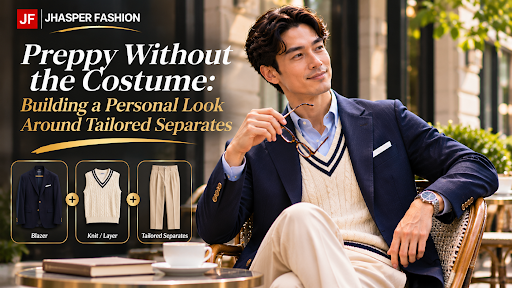
You can borrow from preppy style without dressing as though every piece belongs to a uniform. Choose one recognizable detail, balance it with quieter separates, and let the fit make the combination personal. A button-down collar or a tailored jacket may provide enough direction. You do not need to assemble every familiar reference in the same outfit.
Choose One Preppy Reference
Start with the element you actually like. Perhaps it is the shape of a button-down collar, the contrast between a navy jacket and lighter trousers, or the neatness of a tucked shirt. Naming that detail helps you build an outfit around a preference rather than a shopping list.
Keep the other decisions uncomplicated while you experiment. If the collar is the focus, try a plain jacket before introducing a pronounced pattern. If the jacket supplies the character, let the shirt support it without adding another competing idea.
This is an editing exercise, not a rule against color or decoration. You may enjoy both. Add them deliberately, checking whether each addition contributes something you want. Removing a tie or changing one color can sometimes make the outfit feel closer to your own habits.
Balance the Shirt, Jacket, and Trousers
Consider a hypothetical combination: a pale blue button-down shirt, a navy separate jacket, and stone-colored trousers. The colors provide a starting point; the proportions determine whether you enjoy wearing them together.
Look at how much shirt appears above the jacket fastening and how the trouser shape relates to the jacket body. A roomier trouser does not automatically require a tight jacket, nor does a closer jacket demand narrow trousers. Try the complete outline and decide where you want definition and ease.
Texture can keep a restrained palette interesting. Compare the shirt’s surface with the jacket cloth rather than adding a pattern immediately. Then look from a few steps away. If the outfit feels too busy, simplify one element before changing the whole combination. You are looking for a relationship you like, not a prescribed shape for your body.
Let Personal Fit Finish the Look
Explain the impression you want in ordinary language: neat without feeling rigid, perhaps, or relaxed while still clearly tailored. Say whether you expect to wear the jacket buttoned and whether the shirt will usually be tucked in. Those habits help make the discussion specific.
The shirt collection at Jhasper Fashion includes button-down collars, while its sports jacket range shows notch-lapel options. These are pieces you can discuss individually, rather than evidence of a dedicated preppy package. Its press page also notes Tripadvisor Certificate of Excellence recognition over five consecutive years, 2014–2018. Connect any order to your preferred combination, with the shirt and jacket considered together.
Check the result sitting as well as standing. If you are continually arranging a collar or pulling at a sleeve, describe the problem before assuming the overall style is wrong for you.
Choose one reference to try this week. Build a complete outfit around it, wear it in an appropriate everyday setting, and notice what feels natural. Personal style becomes easier to recognize when you can explain which details you chose and why you kept them.

Before Reconnecting Equipment: Drying Time After Contact Cleaning Explained

Best LLC Formation Services Compared: Pricing, Features, and Support in 2026

A $95 Jacket on a Rail Where Nothing Else Moves
Who Is Gale Burnick? The Story Of George R. R. Martin’s Ex Wife

Who Is Hermann Nicoli? The Full Story Of Candice Swanepoel’s Former Fiancé

Who Is Alicia Dove? The Life Story Of Corey Taylor’s Wife
-
Celebrity4 months ago
Who Is Gale Burnick? The Story Of George R. R. Martin’s Ex Wife
-
 Celebrity4 months ago
Who Is Hermann Nicoli? The Full Story Of Candice Swanepoel’s Former Fiancé
-
 Celebrity4 months ago
Who Is Alicia Dove? The Life Story Of Corey Taylor’s Wife
-

 Celebrity4 months ago
Meet Carole Rogers: Everything to Know About Kenny Rogers’ Daughter
-

 Celebrity4 months ago
Who Is Sydney Davis? The Full Story Of Billy Bush’s Ex Wife
-

 Celebrity4 months ago
Who Is Anna Hillinger? The Full Life Story Of Mike Shinoda’s Wife
-

 Celebrity4 months ago
Who Is Demacio Castellon? Life Story Of Nelly Furtado’s Ex Husband
-

 Blog3 months ago
What Is Sosoactive? A Complete Guide to the Digital Platform